Report by Lezlie Jenkinson, South Africa
MMy recent trip to Namibia was very successful, giving me the opportunity to reconnect with remote communities, strengthen our network of amma4africa distributors, and continue supporting schools through the LEAP programme.
Reconnecting with Amma4Africa Distributors
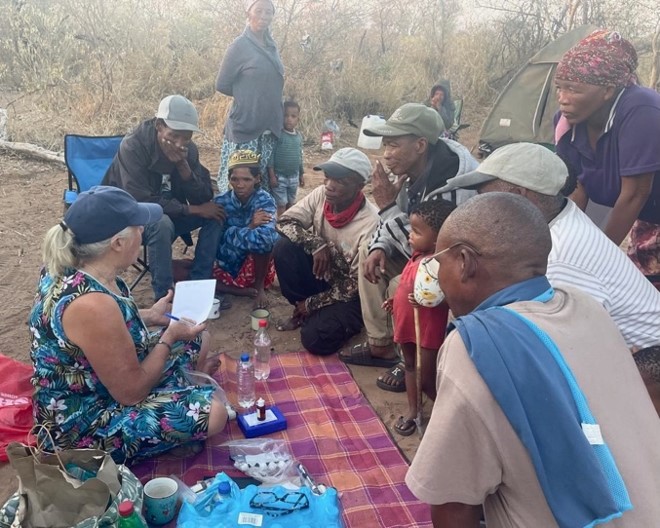
On previous visits, I established a network of amma4africa distributors among Bushmen and other communities, and it was wonderful to see them again. While some had stopped distributing, others had continued their work, and I was fortunate to recruit several new distributors. Even some of the world’s finest trackers have joined the ARHF team, helping to distribute supplements in their villages.
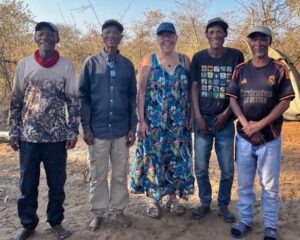
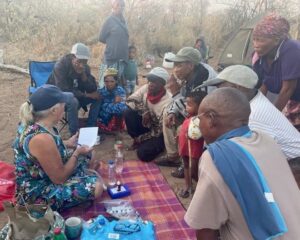
(L) Bushman trackers becoming distributors (R) Training and supplying volunteers
The Bushmen trackers are members of the San peoples of southern Africa, whose generations of ancestral knowledge have given them an extraordinary ability to read the natural environment and track wildlife across challenging terrain. I met with them at an old hunters’ camp, where they were preparing to train the next generation of trackers.
Ongoing Health Challenges
Distributors report that cases of TB have decreased in their villages since PC300t was introduced. However, many community members continue to experience serious respiratory problems. Previous TB infections have left some with lasting lung damage, making them more vulnerable to other respiratory infections. Exposure to harsh tobacco smoke and smoke from indoor cooking fires adds to these challenges, and coughing and emphysema remain common concerns.
Malaria, which was not previously a major problem in the area, has also resurged following unusually heavy rainfall that created favourable conditions for mosquitoes to breed. I have now supplied distributors with PC240m so they can make it available for prevention.
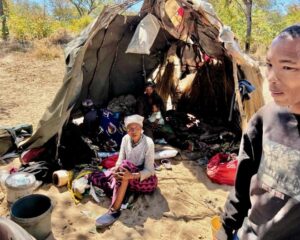
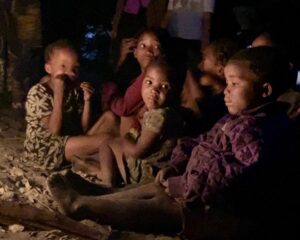
(L) Basic living conditions (R) San children at a campfire
Food security is another concern. The Bushmen rely on a combination of gathered and cultivated foods, which they sometimes have to share with elephants. Their traditional gathering areas have become increasingly restricted by hunting concessions, conservation fences and drought. Drought relief is limited to basic supplies, including highly refined maize meal (mielie meal), sugar, tea, sunflower oil and tinned pilchards.
LEAP Continues to Make a Difference in Schools
It was encouraging to see that LEAP remains a valued resource in rural schools. Most of the schools already using the programme have continued to do so, and both pupils and staff are still enjoying it. In some schools, I replaced speakers that had stopped working, while others had gone missing.
An important development on this trip was beginning work with Raban Amakali, Education Officer in Tsumkwe, to introduce the LEAP programme to first-time pupils and their parents. Speakers will rotate between participating schools, with the Head of Bushmen Schools also rotating between schools to monitor their use and support the programme.
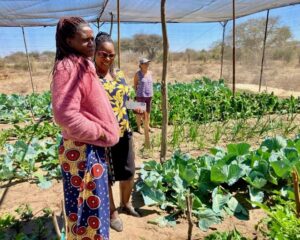
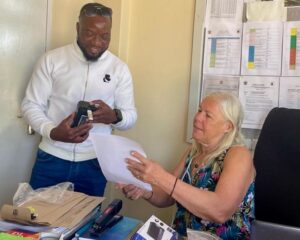
(L) Vegetable garden at LEAP school (R) Raban Amakali, Educ. Officer in Tsumkwe
LEAP is now being used in 51 schools, benefiting 14,255 pupils.
The photo shows a Bushmen school with a thriving vegetable garden. The garden was established with seeds we supplied to help supplement the pupils’ meals—a wonderful example of practical support making a difference to school life.
Preserving Bushmen Musical Traditions
Tuka, the oldest man in one of the villages, still knows how to make and play the traditional four-stringed pluriarc (see photo). In descriptions of Ju/’hoansi musical traditions, this instrument is known as the lloq’àcè. It consists of several curved wooden bows, each carrying a string, attached to a shared resonating body. The strings are plucked to produce music, which is traditionally associated with singing and dancing.
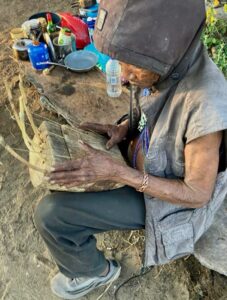
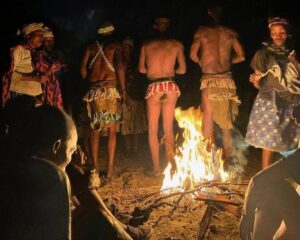
(L) Tuka and his lloq’àcè (R) Traditional singing and dancing
I would love to see these musical traditions preserved and passed on to younger generations. I have therefore asked Tuka to make a pluriarc for me and, importantly, to teach young men in the community how to play this remarkable traditional instrument.
A Successful Visit
Overall, it was a very successful trip. Reconnecting with dedicated amma4africa distributors, welcoming new members to the team, addressing ongoing health concerns and seeing the continued commitment to LEAP in schools were all encouraging. I returned home pleased with the progress made and hopeful for the continued impact of this work in the communities we serve.

Stories of Hope & Impact