by Dr Klaus Schustereder –
Klaus Schustereder is president of Physis Foundation (Switzerland) and has extensive experience in
working with PC Resonances ever since 2005. Physis Foundation and ARHF are partner organizations that
work closely together on projects in Africa and beyond.Amma4Africa DRC
The connection with Angola came about through my friend Manuel Mendoca. Manuel had put me in touch with his friend Tito in Luanda, Angola’s capital. Last autumn, Tito opened an outpatient clinic in Luanda. From the very beginning, Tito was very interested in the work of the Physis Foundation and the Amma Resonance Healing Foundation.
I had undertaken medical missions in various countries. It was important to me to receive an invitation from the clinic. Right from the start, I had the feeling that Luanda would bring something new. New not only for the people there, but also in the way we have so far been making Resonance Healing available to the people in Africa.
For the past 20 years, Resonance Healing has been a grassroots movement. Despite its extraordinary therapeutic success, PC Remedies have not yet been recognized as a healing method in any country. The uniqueness of the approach made it difficult to find points of reference within 20th-century medical thinking. Peter Chappell’s thinking was shaped by his training as a homeopath. His thinking and understanding of healing were dominated by his clinical observations as a homeopath. Attempts to reconceptualize Resonance Healing through the theoretical framework of homeopathy proved difficult. On the one hand, homeopathy has little credibility within 20th-century medicine. On the other hand, the healing method developed by Peter Chappell did not correspond to the highly individualised methodology of homeopathy as developed by Hahnemann. Whilst the ARHF focused primarily on supporting people with trauma and epidemiological diseases, the Physis Foundation had set itself the goal of conceptualizing clinical observations through PC Remedies and providing a theoretical model.
Even during my first conversation with Tito and Manuel, I had the feeling that Angola offered the opportunity to work in partnership with the authorities. I have been working with PC Remedies for more than 20 years, and time and again I have asked myself: how can I reconcile with my conscience the decision not to help people when the medical approach is cost-effective, efficient, simple and safe? This question has always weighed heavily on my mind.
After all, medical care is not only a human need, but also our duty towards our fellow human beings. The legal framework governing which therapeutic approaches are permissible cannot simply be ignored. Even though PC Resonances have evolved from the cradle of homeopathy and represent a far less individualized therapeutic method, I have always regarded Resonance Healing as a further development of homeopathy.
Delving into the scientific literature on water has helped me. It became increasingly clear to me that homeopathy is not, as is so often claimed, a form of energy therapy, but rather a form of information therapy. The connecting element between classical homeopathy and PC Resonances is water. In recent years, it has become clear to me that water is a substance which science does not yet fully understand. The realisation that water – the fundamental substance of life – cannot yet be explained in all its aspects came as a great surprise to me.
The more I delved into scientific publications, the more mathematical formulas came into play. I saw beauty in the formulas. Eventually, I reached an inner turning point. Something stirred within me, and the hunger and thirst I had felt for years to explain what happened to patients who took homeopathic remedies or experienced remarkable improvements through Resonances – this intellectual need for understanding – transformed into a longing for detailed observation of clinical improvements and the joy that comes with them.
Helping people and bearing witness to how their lives improve is like bringing light into this world – light that shines through people as they become healthier. What my heart had clearly sensed 20 years ago – that invigorating refreshment and joy – was no longer clouded by doubts arising from intellectual shortcomings. The gaps in our scientific understanding of medicine are not growing larger, but smaller, through our work with Resonance. As witnesses to extraordinary clinical outcomes, we can contribute to building a bridge between chemistry and modern physics through medicine (as a branch of biology). As medical professionals, we can help to better understand human life in all its dimensions.
With this personal development and inner attitude, I travelled from Switzerland on 11 July first to Paris and then on to Luanda. In Angola, I was met by Dr Joao and the administrator of the clinic, Jorge. In the first three days, I did not see a single patient. The clinic had a poor reputation. There were many problems. The rent had not been paid for six months. The staff hadn’t been paid for four months. I tried to understand what had happened. After all, the clinic had only opened a year ago.
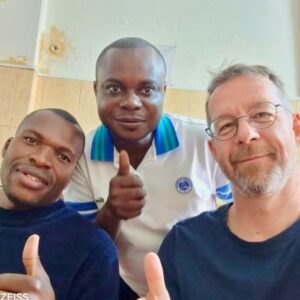
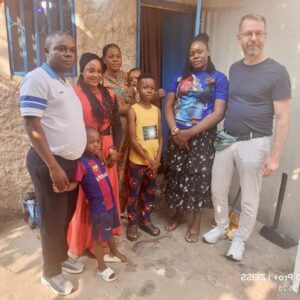
Photo: L to R Jorge, Dr Joao and Klaus Photo: Meeting Dr Joao’s family
I had no interest in exacerbating internal tensions. After all, I had worked as a doctor in various countries. I had gained experience in the Central African Republic, Cameroon, Guinea-Conakry, Zambia, China and Afghanistan. I am no stranger to complex situations. The staff needed hope. It was clear to me that, with Resonances, a business model could be developed that would allow for a sufficiently large profit margin to pay everyone regular salaries in future.
In the past, I had often made the mistake of theorizing too much during medical missions. This time, I wanted to let the results speak for themselves. On the second day after my arrival, we went on a tour by car. We drove to the peninsula in Luanda with its magnificent beaches. There we came across many homeless people. One man was limping, and my colleague Dr Joao went over to him. The man was about 45 years old and had a rag tied round his left leg. My colleague Dr Joao explained that the wound on his leg was a Buruli ulcer.
In Angola, many people suffer from this condition, said Joao. We promised the man, whose name was Dédé, that we would come back tomorrow or the day after to treat his leg. Sure enough, on Wednesday we drove back to the peninsula to treat Dédé. First, we picked up dressing materials and hydrogen peroxide from the pharmacy. I also prepared a bottle of PC1 (The PC Resonance for hiv/aids) for the man. We found Dédé, who lives as a homeless person near the beach. We treated his leg and agreed to return on Friday. When we saw Dédé again two days later, we were all (Jorge the caretaker, Joe the driver and me) surprised by the dramatic change in the ulcer on his left leg. Joe and Jorge, although they are neither nurses nor doctors, could immediately see how much the wound had improved.
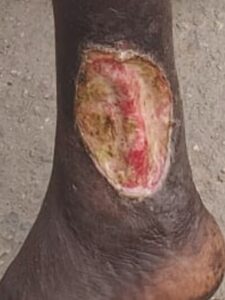
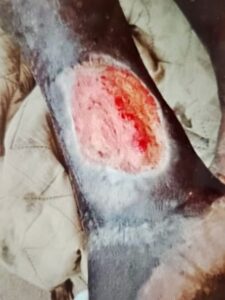
Photo 1: Buruli ulcer before treatment Photo 2: Granulation tissue after 8 days
I arrived in Luanda on Saturday evening, 11 July. The clinic had been, as I already mentioned, in a very poor state for months. It took three days for word to spread that a white person was at the clinic. On Wednesday, when we saw Dédé again, around 10 patients with various ailments turned up. On Thursday, I saw a further 15 patients, and on Friday, around another 15 patients received PC Remedies. I’d already prepared labels whilst in Switzerland.
We bought alcohol and bottles of water locally. Both the consultations and the PC Remedies were free of charge. The administrator, Jorge, was very interested in my work right from the start. He asked the right questions and understood that, unlike the current business model, PC Remedies would yield a much higher profit margin. From the outset, I made it clear that we would provide the PC Remedies to the clinic free of charge. This meant we could set up a pharmacy and would only have to pay for the 70 per cent alcohol and the labels. Whilst I was still in Luanda, Jorge took the initiative to have the French-language labels I’d brought with me translated into Portuguese. He compared quotes from various companies.
Jorge is the man at the clinic who could get things off the ground. He’s also always very responsive on WhatsApp. We’ve been in touch almost daily so far. The clinic has enough space to set up a laboratory. The electricity supply in Luanda is very stable. A laboratory would help to produce systematic, objective data. This could be of enormous value. Evidence of significant laboratory changes triggered by resonance phenomena, alongside secondary clinical improvement, would be an enormous contribution to medicine. What homeopathy was unable to achieve in the past, resonances can achieve in the future. That is, to generate matter from an electromagnetic field within a living system. This doesn’t require much infrastructure. We could set this up in Luanda. Staff could also be recruited there.
In every country where I undertake medical missions, I try to get in touch with the authorities and apply for authorization to practice officially as a doctor. Jorge was helping me to get in touch with the Austrian Honorary Consul in Luanda. On Thursday afternoon, we spent four hours trying to find the consulate in Luanda. Unfortunately, we failed. An email sent the following day was finally replied to by the consul after my return. The application for an official license has been submitted. I hope to receive a response soon. The consul said it would be helpful not only to work at the clinic for my Angolan friends, but also to initiate another project.
On Saturday, I saw nine of the patients again whom I’d first seen only on Wednesday and Thursday – that is, two to three days earlier. They were all feeling a little better. The patients could feel the difference, and I could see it in their eyes. Even after more than 20 years, I still feel a sense of wonder and deep inner satisfaction.
The clinic’s operational situation is cause for concern. Dr Joao is no longer working at the clinic. We need to find a new doctor and train him/her. Training is crucial. I tried to help and cover the rent for the last six months. The nurses and carers are keen to embark on a new path. The clinic’s owners are enthusiastic about the medical and business management concept I suggested. A successful collaboration between the clinic, ARHF and PHYSIS will take time. The Honorary Consul has encouraged me to develop a project together with the clinic, which we can present to the Secretary of the Ministry of Health on my next trip to Luanda. What project?
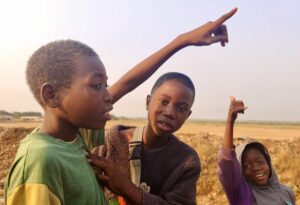
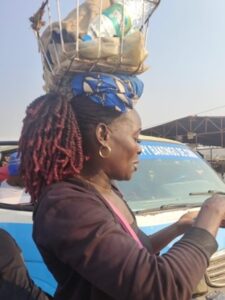
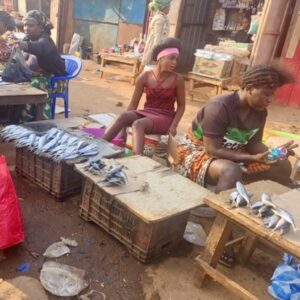
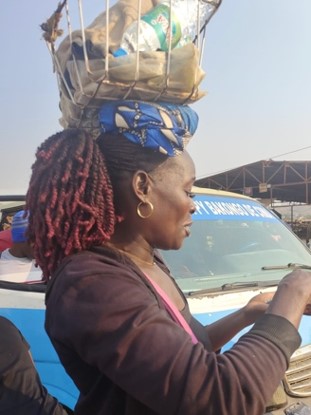
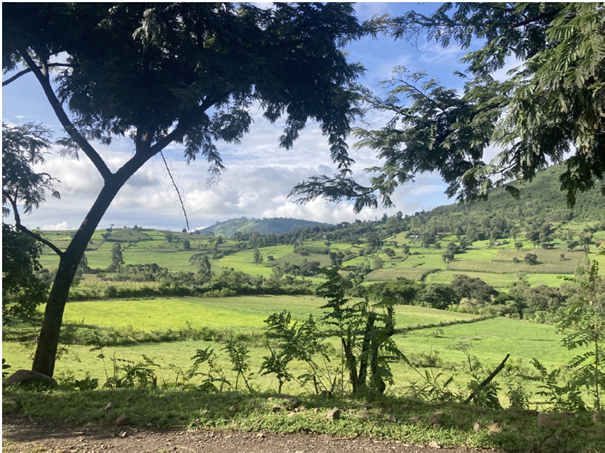
Photos: Impressions of life in Angola
The street children of Luanda had moved me deeply. As I boarded the Air France flight to Paris on 18 July, I was overcome by a deep sense of sadness. Of all my encounters with people in Angola, it was above all the gazes of the homeless children and adults that not only caused me inner pain but even filled me with shame. I was surprised by my own reaction. Dédé too – the 45-year-old homeless man with a terrible wound on his left leg – had made an unexpectedly deep impression on me. Not because of his wound on the left leg, but because of what his eyes did to me. The children and Dédé revealed a spiritual world of such breadth and depth that I had previously seen in people from Central Africa. Feeling too insecure and shy, weighed down by a thousand thoughts, I had not previously dared to engage with the poorest of the poor. It immediately dawned on me that these people were healing me just as much as I was trying to help them.
What moves our hearts is like a compass. We should follow what we clearly feel deep in our hearts. Medical aid for homeless children and adults in Luanda is what I want to do together with the clinic. Hopefully this might be of interest to the government. I hope to be able to build that way a collaboration with the authorities.
One point I hadn’t mentioned before was a visit to a military camp just outside Luanda. Angola had 25 years of civil war. Many people are still traumatized. In Afghanistan, I had seen excellent results with people traumatized by war. Collaborating with the military would be an important step towards gaining credibility. We were able to find out who at the army we needed to contact. During a long conversation with an officer outside the military camp, we were encouraged to submit a project to the Angolan military.
On 18 July, I flew back to Paris as planned. The return flight took off on time. I made notes in my diary. Images and voices of patients came to mind until, at some point, I fell asleep and was woken by the flight attendant. There was an emergency on board which kept me occupied all the way to Paris. The Air France crew were grateful to be able to delegate the situation to me. I had all my training certificates stored on my computer, and the Air France crew encouraged me to join the ‘Doctor on Board’ community of Air France. Five days after my trip, I received an email from them with a credit of 6,000 Air Miles plus a 300-euro bonus. With this, I can now start planning my next flight to Luanda.

Stories of Hope & Impact